
What is tissue culture?
Tissue culture is a biotechnological method wherein plant cells, tissues, or organs are cultured under sterile and controlled environmental conditions on a suitable nutrient medium, resulting in the formation of new plants. It is based on the principle of totipotency, which states that, given the right circumstances, every plant cell has the innate capacity to regenerate into a whole plant.
Tissue culture in Coffee
In coffee, two distinct and different pathways are employed to generate tissue culture plants, and they were
1. Organogenesis and
2. Somatic embryogenesis
Organogenesis
Organogenesis refers to the formation of organs, such as shoots and roots, from plant tissues under in vitro conditions. In coffee, explants such as leaves, hypocotyls, and nodes were used to regenerate shoots and roots. Murashige and Skoog (MS) media is frequently employed in this process in conjunction with auxin (IAA and IBA) to induce roots and cytokinin (BAP or Kinetin) to stimulate shoots. It is regarded as the best way of propagation since roots and shoots are produced directly from the plant tissue. However, tissue browning from phenolic exudation, severe contamination, and irregular and infrequent regeneration have limited its utility in coffee tissue culture programs.
Somatic Embryogenesis
In this process, somatic (non-reproductive) plant cells develop into embryos called somatic embryos that can further grow into complete plants under in vitro (tissue culture) conditions. These somatic embryos usually pass through different stages of development (globular → heart → torpedo → cotyledonary) and finally become plantlets. However, each stage is critical, limited, and time-consuming. Somatic embryogenesis in coffee was first demonstrated as early as the 1970s by Staritsky, and subsequently embryo formation and plant regeneration were achieved in both arabica and robusta coffee during 1977 -1980 (Sondhal and Sharp). During 1980 – 90, many laboratories, including India, were engaged in coffee tissue culture and made tangible progress using various explants. During 1990-2000, the bulk of techniques were standardised utilising a variety of explants, and plant regeneration from diverse commercial cultivars was accomplished. In order to grow coffee tissue culture plants, the Coffee Board of India has partnered with several commercial tissue culture farms during this time.
Additionally, the Department of Biotechnology’s government tissue culture facilities were used. Despite the fact that both robusta and arabica were able to achieve somatic embryogenesis, both species exhibited genotypic and particular differences, which are outlined below.
| Component/ Parameter | Arabica | Robusta |
| Callus mass | Large | Low to moderate |
| Callus induction media | MS + auxins (2,4-D (1-5 mg/l)) + cytokinins (BAP, kinetin) | MS + auxins (2,4-D 0.5 to 1.0 mg/l, NAA) + cytokinins ( kinetin) |
| Embryogenic callus | Slow (approx 90 days) and less prolific | Rapid ( 35-50 days) and abundant |
| Somatic embryo size | Large and uniform | Variable and irregular |
| Embryo yield | Low to medium | Moderate to high |
| Genotypic specificity | High | Moderate to high |
| Abnormal embryo | low | high |
| Embryo conversion to plantlet | Moderate to high | moderate |
| Bioreactors | Under optimization | Optimized and successful |
| Automation | Moderate | Moderate to high |
| Acclimatization | Sensitive | Variable response |
| Major bottleneck | Maintaining genetic fidelity | Maintaining genetic uniformity |
| Economic feasibility | High cost | Medium to high cost |
| Advantages | F1 hybrid propagation and genetic transformation | Genetic transformation and mass propagation |
| Disadvantages | High genotype specificity and time consuming, somaclonal variation | Reduce genetic diversity having long term negative effect on genetic improvement |
Important steps to consider before tissue culture commercialization
1. Plant selection
The basic objectives of commercial exploitation of tissue culture in arabica and robusta differ slightly because of their mode of reproduction. Since arabica is a self-pollinated crop where the pollen of the same flower or the flowers of the same plant can fertilize, it gives rise to the offspring with high genetic uniformity. Therefore, for tissue culture propagation, only F1 hybrids exhibiting heterosis with a high yield index, greater adaptability, enhanced resistance, etc., may be selected.
In robusta selection of mother plants is far more difficult and requires a multifaceted approach combining scientists from different streams, extension personnel, and planters over time rather than instantaneously or with short-term assessment. The rigorous assessment, which involves the identification of the best mother plants with consistent yield, wider adaptability, drought tolerance, and quality, needs to be mapped to assemble a core collection of plants required for commercial tissue culture. In the absence of these parameters, the whole tissue program of robusta is not only useless but also detrimental.
2. Fecundity or compatibility test
Though not important for arabica coffee due to its self-fertility nature, this is extremely important for robusta coffee due to its cross-pollinating nature. The analysis of the pollination dynamics involving pollination synchronization, stigma receptibility, self-incompatibility among the selected plants, and the direct measurement of fruit set over a period of time are important parameters. This will ensure the clones selected are compatible.
3. Adaptability assessment
In robusta coffee, variable performance of various genotypes is observed in different environmental conditions. Therefore, it is important to ascertain that all the selected plants/ genotypes have broad-spectrum adaptability by assessing their performance in different agroclimatic zones.
4. Genetic distinctiveness
Assessment of genetic diversity between the selected plants needs to be confirmed by molecular tools so as to ensure that diversity is maintained for heterosis. The chosen clones should ideally form distinct groups according to their genetic makeup.
Assessment of Tissue Culture Plants
1. Agronomic evaluation: It is most important to evaluate the performance of the mixed tissue culture clones raised through tissue culture and compare them with the seedlings from the selected clones under similar conditions to determine if there is any yield increment.
2. Genetic fidelity: Before tissue culture plants can be widely commercialised, genetic fidelity must be ensured. There are excellent tools now available to monitor if the tissue culture plants have changed significantly throughout the course of the extended in vitro culture. Until now, it was believed that plants regenerated through tissue culture are genetically identical. However, current research based on marker analysis and coding gene sequencing has disproved the notion (for details, see the following:
Comparative genetic assessment of somatic embryo– and seed-derived plants of two arabica hybrid coffee cultivars. [DOI]
Genomic alterations in the coding region of tissue culture plants of Coffea arabica obtained through somatic embryogenesis revealed by molecular markers.
[DOI]
Assessment of genetic homogeneity of somatic embryo-derived and seed-derived plants of a robusta coffee cultivar using molecular markers and gene sequencing. [DOI]
Research carried out in India and what we learnt
The Central Coffee Research Institute, celebrating a milestone century of coffee research in India, had initiated coffee tissue culture as early as the 1980s, and by 1995-98, the scientists working in the Division had standardized the entire protocol for in vitro regeneration of various arabica and robusta genotypes. To fast-track the technology, Coffee Board has onboarded at least three private tissue culture firms and supplied enough somatic embryos for large-scale propagation. Subsequently, a govt facility was also involved in hardening and scaling up the production of tissue culture plants. However, the lengthy tissue culture process of coffee and other related problems was then found to be the bottleneck. During 1995 to 2004, the Tissue Culture Division established trial plots in 44 locations involving 16000 tissue culture-raised plants of both arabica (Cauvery, Sln. 9 ) and robusta (C xR) and compared them with seedlings. These plots are primarily established in planters’ fields and research farms of the Board establishment.
Vegetative Growth and Yield Assessment
The agronomic evaluation of arabica genotypes, specifically Sln. 9, has revealed that, except for a few, the majority of cumulative vegetative growth parameters are relatively identical in tissue culture plants and seedlings, though significant variation was observed among different genotypes. In the Sln. 9 variety, the yield pattern, bean size, and bean grade were almost similar in tissue culture and seedlings. However, among Cauvery genotypes, variability was observed in growth and reproductive parameters of tissue culture plants and their respective seedlings. (Details PLACROSYM 2002).
Agronomic analysis of the robusta genotype (CxR) showed that there were no statistically significant differences between the tissue culture plants and seedlings in terms of vegetative development and cumulative production (Open Life Science 2017: 12, 1-11)
Genetic Fidelity
It is imperative to test the genetic fidelity of tissue culture plants raised through somatic embryogenesis before being subjected to industrial production. In coffee tissue culture, 2,4-D is widely used for callus induction and somatic embryogenesis all over the world. In arabica, high concentration of 2,4-D ( 1 – 5 mg/l) is used compared to robusta genotypes (0.5 to 2mg/l). There was enough evidence to state that 2,4-D can cause genetic damage, mutations, and chromosomal aberrations in both plants and animals at certain concentrations. Additionally, it has been demonstrated that .2,4-D can induce the formation of reactive oxygen species (ROS), which can damage DNA. Earlier, it was thought that coffee plants generated through somatic embryogenesis are genetically identical with minimal variation.
Scientists at CCRI’s Biotechnology Center recently conducted a groundbreaking study in which they examined the genetic fidelity of tissue culture plants and seedlings of the robusta (CxR) and arabica (Sln. 9) genotypes. For the first time, they have used highly efficient molecular markers and sequenced several functional genes. In Arabica, the presence of variable frequency of single-nucleotide polymorphisms (SNPs) and insertions and deletions (indels) across different genes was observed in both tissue culture and seedlings. Sequence variability did not significantly differ between plants developed from seeds and those obtained from somatic embryos. According to this study, there is little genetic variation in Arabica between tissue culture plants and seedlings, depending on the genotypes.
In robusta, which is a cross-pollinated crop, molecular analysis employing molecular markers and functional gene sequencing revealed no discernible genetic change between tissue culture plants and seedlings. This clearly showed that. Therefore, a comprehensive strategy to help India’s thriving coffee sector should be decided by stakeholders, including scientists, administrators, and small and large coffee growers.
Planting seedlings through judicial selection is an equally effective way of propagation as tissue culture.
Tissue culture plants in the Indian coffee landscape
During the past few months, many growers have asked my opinion about the tissue culture plants. However, it is the personal choice of a grower, and because I’m not a man of grey, I’ve attempted to highlight different aspects of coffee tissue culture plants that are backed up by concrete scientific data. In many parts of India, robusta and arabica are grown side by side. The genetic diversity of Indian arabica coffee types is far greater than that of many other coffee-growing nations. In a similar vein, robusta genotypes are shown to have a significant genetic variability. The farmers themselves are the ones who preserve the genetic diversity. They have preserved the diversity for more than a century. In robusta, there are various ways to increase yield by adapting simple and practical methods without compromising the genetic diversity.
Furthermore, each technology has its merits and demerits, and tissue culture technology is no exception. Tissue culture technology held great promise in gene editing, which is more important in the present context. Therefore, a comprehensive strategy to help India’s thriving coffee sector should be decided by stakeholders, including scientists, administrators, and small and large coffee growers.
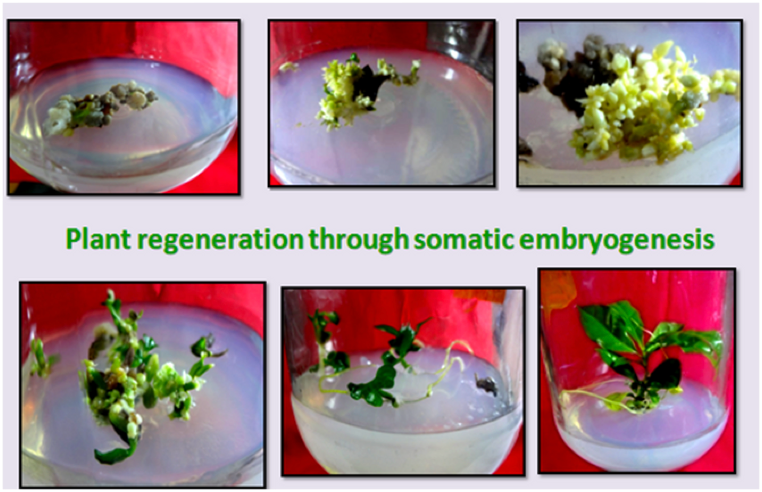
Stages of plant regeneration through somatic embryogenesis in vitro
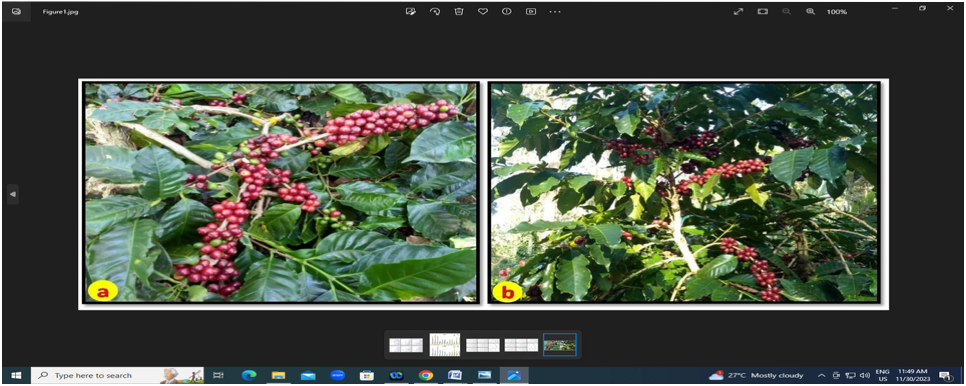
Field performance of coffee plants under cultivation conditions
 A Light Through My Window
Leave a comment