
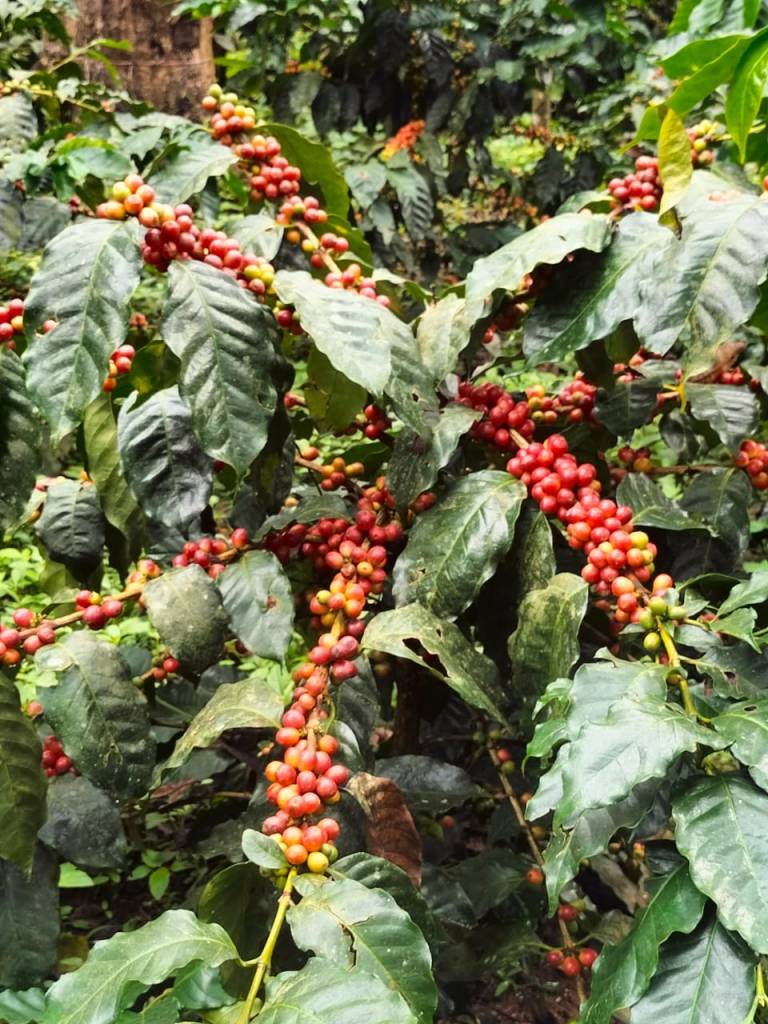
A picture of Arabica variety taken in Coorg, Karnataka, India
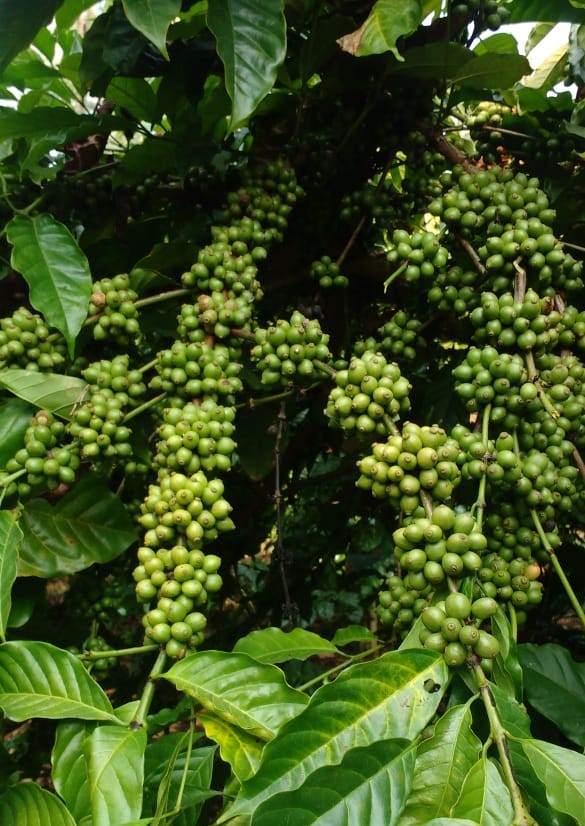
A picture of Robusta variety taken in Coorg, Karnataka, India
Years ago, on a rainy morning, I arrived in the coffee land of Balehonnur. At CCRI, I was enveloped by a curtain of heavy rain, a cool breeze, and the swaying of large trees.
Planned to be a stop gap arrangement, little did I realize that I would linger and linger and here I would make my relationship with coffee. Years later, as I look back on those days, it tells me, “Oh, you are the same young man who came here yesterday.”
As I immersed myself in my new surroundings, the rains happened to cease, and I was requested to accompany the seniors to the field, which became a routine in later years.
As I entered the field of play, my boss requested that I identify and describe the distinguishing features of the Arabica and Robusta varieties. He told me, “You have a Ph.D. from the university, don’t you?” and posed this simple question. I was stunned and perplexed, and I did not dare to guess the answer because my mind was entirely blank, like the sky that had cleared on that rainy day. I had a sort of relevant and that is when all of my egos vanished and I bowed before the supreme brilliance (as I still do!). That was my first experience with coffee research.
As I reflect on this incident, I realize that embracing our ignorance is not a mistake but rather a wise decision to open the window and allow light to infiltrate and illuminate our lives.
Without further ado, let me jump right into what distinguishes Arabica from Robusta varieties:
| Important features | Coffea arabica (Arabica coffee) | Coffea canephora (Robusta coffee) |
| Origin | Southwestern Ethiopia, Boma Plateau of South Sudan | Guinea to Uganda, and Northern Tanzania to Angola |
| Altitude of origin in meters above sea level (masl) | 1300–2000 | 0–1000 |
| Cultivation period (Approximate) | 850 CE | 1870 CE |
| Genetic diversity | Very low to moderately low | High |
| Genetic characteristics | Segmental allotetraploid (cross C. eugenioides × C. canephora) | True Diploid with polymorphic heterozygouspopulations |
| Chromosome number and ploidy status | 2n = 4x = 44 (Tetraploid) | 2n = 2x = 22 (Diploid) |
| Mean 2C DNA content (pg) | 2.44 | 1.37 |
| Mean genome size (Mb) | 1198 | 672 |
| Mean number of stomata /mm2 | 182.0 | 396.5 |
| Mean number of epidermal cells/ mm2 | 450.0 | 697.5 |
| Mean number of plastids in guard cells | 15.96 | 8.75 |
| Mean guard cell length (µ) | 27.13 | 19.84 |
| Mean pollen grain diameter(µ) | 30.54 | 23.86 |
| Lamina thickness(µ) | 281.29 | 195.40 |
| Fertilization and compatibility | Self-pollinated (more than 95%autogamous) and self-compatible | Self-incompatible gametophytic type |
| Bush type | Usually shrub | Tree and/or shrub |
| Growth habit and canopy type | Usually erect with pyramidal shape | Umbrella shape with irregular canopy |
| Optimal growth temperature (◦C) | 18 – 26 | 22-30 |
| Optimum growth precipitation (mm) | 1500 – 2000 | 1500 – 2500 |
| Altitude for cultivation in meters above sea level (masl) | 1000 – 1800 | 400 – 900 |
| Propagation method | Seed | Predominantly seed and cuttings |
| Planting density | High | low |
| Root type | Deep rooted | Shallow rooted |
| Ripening time (Months from anthesis) | 7-9 | 9-10 |
| World production share (%) | 56.56 | 43.44 |
| Yield range (clean coffee kg/ha) | 1200 – 2800 | 2000 – 3600 |
| Fruits: clean coffee | Low (4.5:1 to 5.5:1) | High (4:1 to 5:1) |
| Bean shape | Large, oval, flat and elongated | Small, rounded, oval or elliptical |
| Rust resistance | Susceptible to moderately tolerant | Moderate to high tolerance |
| Nematode resistance | susceptible | Resistant |
| White Stem Borer resistance | Susceptible | Resistant |
| Drought response | Tolerant | Susceptible |
| Organoleptic cup quality | Subtle taste, aromatic | Stronger taste, little harsh and earthly |
| Green coffee caffeine content range (%) | 0.9 – 1.7 | 1.8 – 3.0 |
| Ripe grain chlorogenic acid (% ) | 5.5 – 6.9 | 8.2 – 10.6 |
| Trigonellin (dry matter basis) | 0.8 – 1.7 (1.2) | 0.75 – 1.2 (1.0) |
| Sucrose (%) | 9.2 | 5.4 |
This is the first of many such topics that I’ll be writing on Coffee.
That said, my blog is going to be much more. A conglomeration of poetry, musings, and short stories as an inquiry into the human condition. Curious? Stay tuned!
google-site-verification: googledeecdab15f854e0b.html


 A Light Through My Window
Leave a reply to Dr. Mallikarjun Awati Cancel reply